
Air Source Heat Pump Installation in Walsall, Explained Plainly
Air Source Heat Pump Installation in Walsall with a free home survey, written quote and plain-English costs. Comfortable, efficient heating. Call for a quote.
Replacing a heating system is a big decision, and you shouldn’t have to make it with a salesperson hovering. Eco Air Source Heat Pump Installer is based in Walsall (WS1), and we’re open 7 days, 9am to 7pm, on 01922 302461. Whether you’re weighing up air source heat pump installation in Walsall for the first time or comparing quotes, we start with a free home survey, follow it with a written quote, and explain every cost in plain English before you commit. You’re also welcome to visit us in person.
How a Heat Pump Works
An air source heat pump takes warmth from the outside air, even on a cold day, and uses it to heat your radiators, underfloor heating and hot water. It runs on electricity, but it moves heat rather than creating it, which is why it’s so efficient. The Energy Saving Trust says heat pumps are more than three times more efficient than a gas or oil boiler (Energy Saving Trust, Air source heat pumps, updated 23 Sept 2026).
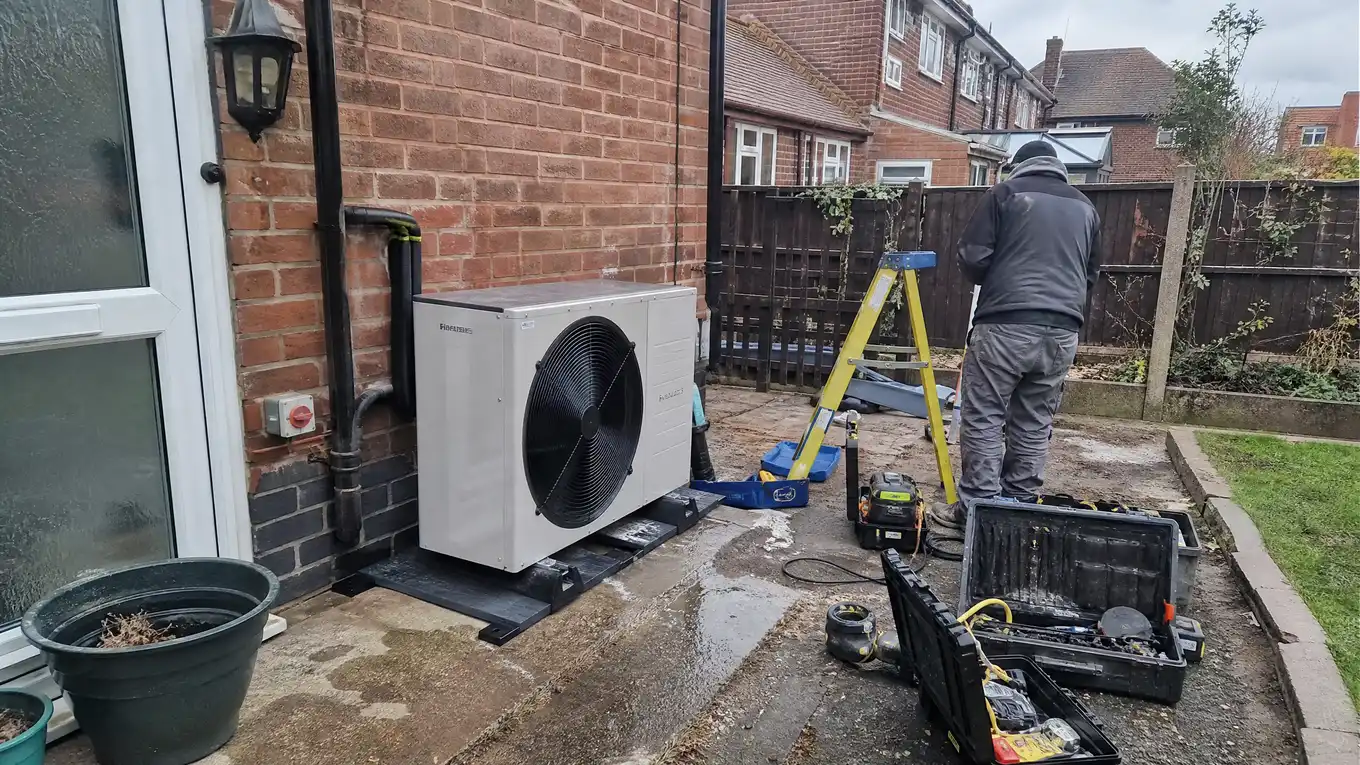
In practice, you’ll have an outdoor unit that looks a little like a slim air conditioning box, pipework linking it to the house, and usually a hot water cylinder indoors. The heating runs at a gentler, steadier temperature than a boiler. Rather than blasting hot and then switching off, the system keeps rooms comfortably warm for longer stretches.
Who Tends to Benefit Most
Heat pumps suit a wide range of homes, but a few situations come up often around Walsall, Bloxwich, Aldridge, Brownhills, Willenhall, Darlaston, Pelsall and Streetly:
- Homes with oil, LPG or electric heating, where the current running costs or fuel deliveries are a headache.
- Owners replacing an ageing gas boiler who would rather move away from fossil fuels than buy another one.
- Landlords looking to future-proof a rental property.
- Homes with decent insulation, or owners planning to improve it.
- Households with outside space for the unit, at the side, rear or occasionally the front of the property.
Not every house is a good fit, and we’ll tell you honestly if yours isn’t. The survey is there to find that out before you spend anything.
Monobloc and Split Systems
Heat pumps come in two main layouts, and the right one depends on your property.
A monobloc keeps all the main components in a single outdoor unit. Water pipes run from that unit into the house. According to the Energy Saving Trust, monobloc systems are cheaper and quicker to install (Energy Saving Trust, Air source heat pumps, updated 23 Sept 2026). They suit most homes and are the usual choice where there’s a sensible spot outside for the unit.
A split system divides the components between an outdoor unit and an indoor unit, joined by refrigerant pipework. The same source notes that split systems can be slightly more efficient. They can make sense where you’d like less equipment outside, where a particular layout works better indoors, or where the property’s design points that way.
For you, the benefit is simple: we don’t push one layout because it suits us. At the survey we look at where the unit could sit, how pipes would run, and where the cylinder would go, then recommend the layout that fits your home and budget. The written quote spells out which we’ve chosen and why.
From First Call to Finished Job
- Call or request a survey. Calls are the quickest way in, though the form works too.
- Free home survey. We look at your property, current heating, radiators, insulation and possible spots for the outdoor unit and cylinder.
- Written quote. You get a clear breakdown, including any extras such as radiator upgrades, so there are no surprises.
- Booking and preparation. Once you’re happy, we agree dates and any preparation needed.
- Installation. We fit the unit, pipework, cylinder and controls, and connect everything to your heating.
- Commissioning and handover. We test the system, set it up properly and show you how to use it.
What Happens on Installation Day
Knowing what to expect takes much of the worry out of it. On the day, we arrive at the agreed time, protect floors and work areas, and talk you through the plan. The old system is usually isolated first, which means your heating and hot water will be off for part of the job. We’ll tell you in advance when and roughly for how long.
The outdoor unit is then positioned on a base or brackets, the pipework is run between the unit and the house, and the hot water cylinder is fitted, usually in an airing cupboard or utility space. The Energy Saving Trust says a cylinder can typically fit in any cupboard measuring at least 80cm x 80cm (Energy Saving Trust, Air source heat pumps, updated 23 Sept 2026). Where the cylinder is unvented, we fit it in line with Building Regulations Part G, which covers hot water safety.
This stage suits homeowners who want a tidy, organised job with a clear point of contact. The benefit to you is less disruption and no guessing. Exact timescales depend on the system and property, so we confirm them in your written quote.
Commissioning and Handover
Fitting the equipment isn’t the end of the job. Commissioning is where we fill, flush and check the system, test the controls, and set flow temperatures and heating schedules so it runs efficiently in your particular home. A heat pump that’s installed well but set up badly will cost more to run than it should, so this step matters.
At handover, we sit down with you and go through the controls in plain terms: how to set the temperature, how the hot water schedule works, and what to expect from the outdoor unit. You’ll get the paperwork and manufacturer information, and we’ll explain what servicing the manufacturer recommends so your warranty stays valid.
This stage is for everyone, and it’s the one people rarely hear about from larger national firms. The benefit is a system that works properly from day one, with someone local on the end of the phone if you have questions afterwards.
What You’ll Gain
- Efficiency. Heat pumps are more than three times more efficient than a gas or oil boiler (Energy Saving Trust, 2026).
- Steady comfort. Gentle, even heat rather than short bursts.
- A move away from fossil fuels. Useful if you’re replacing oil, LPG, electric or an old gas system.
- One system for heating and hot water.
On running costs, we’ll be straight with you. On standard tariffs electricity is nearly four times more expensive than gas, so a heat pump can cost slightly more to run than a new gas or oil boiler. A heat pump time-of-use tariff can bring running costs below those of a gas boiler (Energy Saving Trust, Air source heat pumps, updated 23 Sept 2026). We’ll go through tariffs with you at the survey rather than gloss over it.
The Investment: Costs, Grants and Timescales
Published figures vary because homes vary. The Energy Saving Trust puts the typical UK installation cost at around £12,000 (Energy Saving Trust, 2026). Other guides give wider ranges: £3,000 to £15,000 on average, not including extras such as radiator upgrades (Checkatrade cost guide, 2026), and £5,000 to £15,000 (Worcester Bosch, seen Oct 2026). Heatable suggests £7,000 to £13,000 depending on property size, system design and upgrades (Heatable, 2026).
What moves your price: the size of the heat pump, the layout you choose, the cylinder, pipework distances, and whether radiators need changing. That’s why we give a written quote after the survey rather than a guess over the phone.
The grant route. Homes in England and Wales can get £7,500 towards an air source heat pump through the Boiler Upgrade Scheme (Energy Saving Trust, 2026). You must own the property and be replacing a fossil fuel system such as oil, gas, electric or LPG (GOV.UK, 2026). We are not MCS certified, so if you want the grant, we refer you to our MCS-certified partner, who quotes, installs and applies on your behalf. The grant is taken off what you pay and shown on the quotation and invoice (GOV.UK, 2026). If you don’t need the grant, we install the heat pump ourselves.
Talk to a Local Team
If you’re considering a heat pump in Walsall, Bloxwich, Aldridge, Brownhills or nearby, we’ll give you straight answers and a written quote with no pressure. Call 01922 302461 or request a free survey, and we’re open 7 days, 9am to 7pm.


How It Works
From initial survey to completion — here’s what to expect when you work with us.
Free survey
We visit your home, check the radiators, the space for the outdoor unit and a hot water cylinder, and talk through what you want.
Written quote
You get a clear written quote that shows exactly what is included.
Installation
We fit the heat pump, cylinder and any radiator changes, and agree a start date that suits you.
Commissioning and handover
We test the system, set the controls and show you how to run it.
Related Guides
Helpful articles to learn more about this service.
Air-to-Air vs Air-to-Water Heat Pumps
Air to air heat pump or air-to-water? Learn how they differ on heating, hot water, grants and costs, plus our Air Source Heat Pump Installation advice.
Read guide →Do You Need Planning Permission for a Heat Pump?
Do you need planning permission for a heat pump? Learn when it's not needed, when to check, and how it fits with Air Source Heat Pump Installation in Walsall.
Read guide →How Does an Air Source Heat Pump Work?
Learn how an air source heat pump works, what it costs to run and what your home needs. A plain guide from your Walsall Air Source Heat Pump Installation team.
Read guide →How Much Does an Air Source Heat Pump Cost in Walsall (2026)?
Heat pump cost in Walsall explained: price ranges, the £7,500 grant route and running costs, plus what affects Air Source Heat Pump Installation quotes.
Read guide →How Noisy Is an Air Source Heat Pump?
Learn how noisy an air source heat pump really is, what affects the sound and where to place it. Advice from a Walsall Air Source Heat Pump Installation team.
Read guide →Frequently Asked Questions
Typically between £3,000 and £15,000 on average, not including extras such as radiator upgrades (Checkatrade cost guide, 2026). The Energy Saving Trust gives a typical UK figure of around £12,000 (2026). Your own price depends on property size, system design and upgrades, so we give a written quote after a free survey.
You may be able to if you own the property, are in England or Wales, and are replacing a fossil fuel system such as oil, gas, electric or LPG (GOV.UK, 2026). Most new builds and social housing are excluded. We're not MCS certified, so grant jobs go through our MCS-certified partner, who quotes, installs and applies for you.
Usually not. Most heat pump installations are permitted development, so no planning permission is needed. If you live in a listed building or conservation area, check with your local planning department first (Energy Saving Trust, 2026). We'll look at the position of the unit at your survey and flag anything worth checking.
In most cases, yes. A heat pump normally heats water through a cylinder, which can usually fit in any cupboard measuring at least 80cm x 80cm (Energy Saving Trust, 2026). If space is tight, we'll discuss options at the survey, and unvented cylinders are fitted in line with Building Regulations Part G.
Possibly, but not always. Heat pumps run at lower temperatures than boilers, so some rooms may need larger radiators to heat properly. We check each room at the survey and list any radiator changes separately in your written quote, so you can see exactly what's needed and why before you decide.
Thinking about an air source heat pump?
Call or send a message and we'll arrange a free survey of your home, then send a written quote.