
How Does an Air Source Heat Pump Work?
Learn how an air source heat pump works, what it costs to run and what your home needs. A plain guide from your Walsall Air Source Heat Pump Installation team.
If you’re wondering how an air source heat pump works, the short version is that it moves heat from the outside air into your home, rather than burning fuel to make it. At Eco Air Source Heat Pump Installer, we’re based in Walsall, and we explain this to customers at the kitchen table and at our premises, where you’re welcome to visit. This guide covers the process step by step, what it means for running costs, and what it needs from your home. We’re open 7 days, 9am–7pm, at our Walsall address (WS1).
The Four Steps Behind the Heat
An air source heat pump works much like a fridge in reverse. A fridge pulls heat out of its inside and pushes it into your kitchen. A heat pump pulls heat from outdoor air and pushes it into your heating and hot water.
Here is the cycle in plain terms:
- Fan and evaporator. A fan draws outdoor air over a coil containing a refrigerant, a liquid that boils at very low temperatures. Even on a cold day, the air holds enough heat to make it evaporate into a gas.
- Compressor. The gas is squeezed by a compressor, which raises its temperature sharply. This is the part that uses electricity.
- Heat exchanger. The hot gas passes its heat to the water in your heating system, which then flows to radiators, underfloor heating or a hot water cylinder.
- Expansion valve. The refrigerant cools and turns back into a liquid, and the cycle starts again.
Because the pump moves heat rather than creating it, it can deliver more heat than the electricity it uses. The Energy Saving Trust says heat pumps are more than three times more efficient than a gas or oil boiler (Energy Saving Trust, 2026).
What You’ll See in Your Home
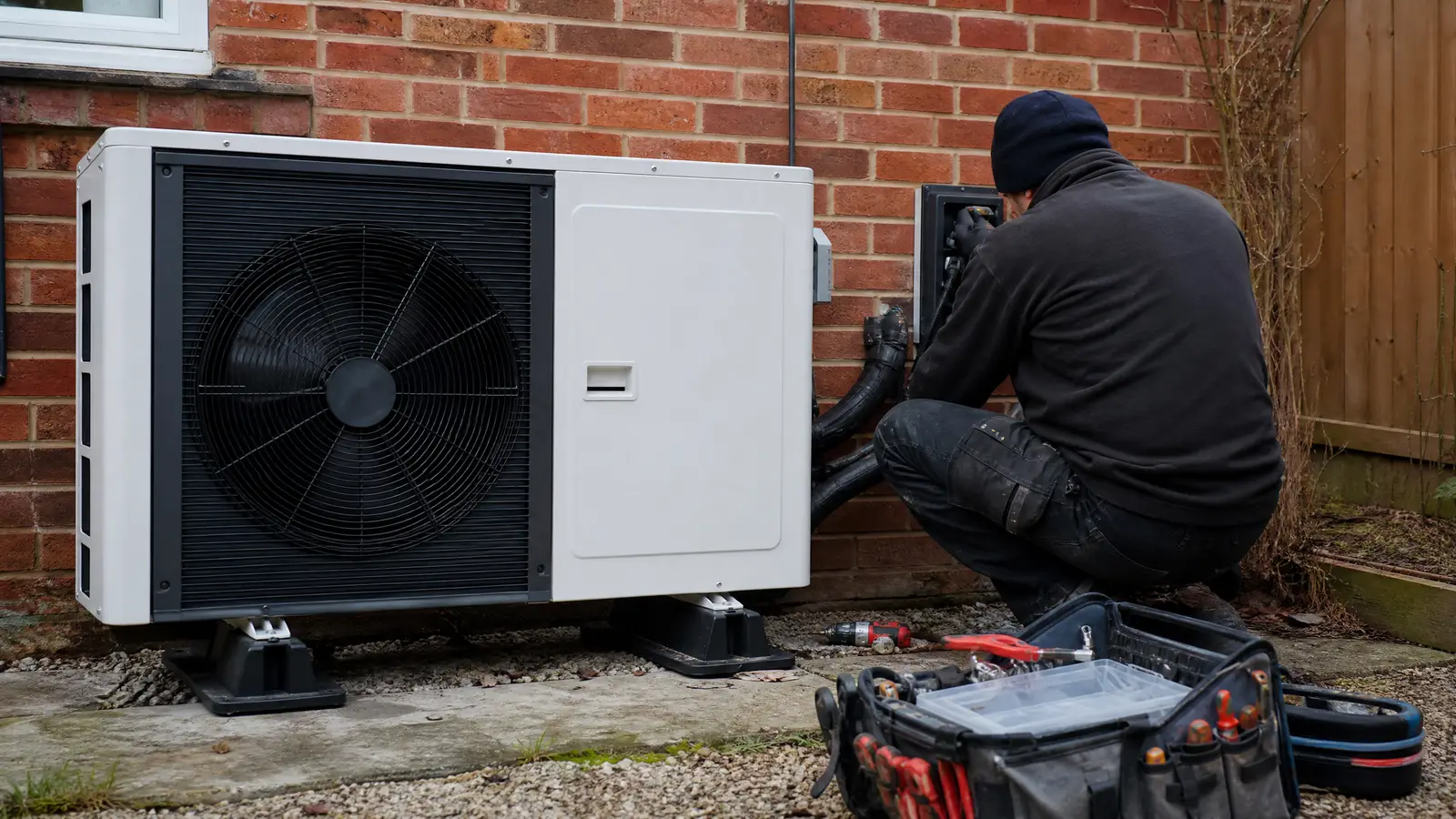
Most people picture something complicated, but the visible parts are few. There is an outdoor unit, a bit like a large air conditioning box, and a hot water cylinder indoors. Your existing radiators and pipework often stay in place, although some rooms may need larger radiators to give the same warmth at a lower water temperature.
There are two common layouts. Monobloc systems keep all the components in one outdoor unit and are cheaper and quicker to install, while split systems can be slightly more efficient (Energy Saving Trust, 2026). We’ll tell you which suits your house after a survey.
A cylinder can usually fit in any cupboard that measures at least 80cm x 80cm (Energy Saving Trust, 2026). Most installations are permitted development, so planning permission isn’t normally needed, but check with your local planning department if you live in a listed building or conservation area (Energy Saving Trust, 2026).
What It Costs to Run, and to Buy
Heat pumps run on electricity, which is priced differently from gas. On standard tariffs electricity is nearly four times more expensive than gas, so a heat pump can cost slightly more to run than a new gas or oil boiler. A heat pump time-of-use tariff can bring running costs below a gas boiler (Energy Saving Trust, 2026).
Installation prices vary depending on the guide you read, which is why we show the range rather than a single figure. The Energy Saving Trust gives a typical cost of around £12,000 (Energy Saving Trust, 2026), while Checkatrade says £3,000 to £15,000 on average, not including extras such as upgrading radiators (Checkatrade, 2026). Your own figure depends on property size, system design and any upgrades. We give you a written quote after a free home survey, so you can see exactly what is included.
Where the Grant Fits In
Homes in England and Wales can get £7,500 towards an air source heat pump through the Boiler Upgrade Scheme (Energy Saving Trust, 2026). You must own the property and be replacing a fossil fuel heating system such as oil, gas, electric or LPG (GOV.UK, 2026).
We are not MCS certified, so the grant comes through our MCS-certified partner, who quotes, installs and applies on your behalf. The grant value is taken off what you pay and shown on your quotation and invoice (GOV.UK, 2026). If you don’t need the grant, we install the heat pump ourselves. Our Air Source Heat Pump Installation page explains both routes.
Key Takeaways
- A heat pump moves heat from outdoor air into your heating system using a refrigerant, compressor and heat exchanger.
- It is more than three times more efficient than a gas or oil boiler (Energy Saving Trust, 2026).
- Running costs depend on your electricity tariff; a time-of-use tariff can bring them below a gas boiler.
- Some homes need a cylinder and larger radiators, which a survey will confirm.
- The £7,500 grant comes through our MCS-certified partner.
Talk to Someone Local
If you’d like to know whether a heat pump suits your home, we’ll explain it simply and give you a written quote. Call 01922 302461 or request a free survey: 01922 302461. See our Air Source Heat Pump Installation page for more.


Frequently Asked Questions
Yes. The refrigerant boils at very low temperatures, so the unit can still draw heat from cold air. It may work harder in a freeze, which is why insulation, correct sizing and radiator choice matter. We check these during your free home survey.
They use the same basic principle, but a heat pump is designed to heat your home and hot water as its main job. An air conditioner mainly cools. A heat pump connects to your water-based heating system, not just to a room.
Yes. Call us or visit our Walsall premises and we'll talk you through the system and the costs in plain English, with sources, before you decide. There's no pressure and nothing to sign on the day.
Thinking about an air source heat pump?
Call or send a message and we'll arrange a free survey of your home, then send a written quote.